Note: Certain details, visuals, and data have been modified or omitted to comply with confidentiality and NDA agreements.
Designing trust into a system that broke it
The problem with sneaker drops
Limited sneaker releases are one of the most emotionally charged purchasing experiences in consumer retail. Demand massively outstrips supply. The window to enter is minutes long. And for most real users, the outcome is always the same: they lose.
That loss is tolerable. What isn't tolerable is not understanding why.
Across platforms like SNKRS, GOAT, and StockX, the experience is structurally broken in three specific ways. Bots dominate entry windows before real users have a chance. Raffle outcomes are announced with zero explanation no context, no entry count, no selection logic. And after repeated failure, users disengage entirely not because they stopped wanting the product, but because the system stopped feeling worth engaging with.
My job wasn't to solve scarcity. It was to design a system where losing felt fair and where users wanted to come back anyway.
What users actually said
I conducted competitive analysis across SNKRS, GOAT, and StockX, ran one-on-one interviews with sneaker enthusiasts, and ran task-based walkthroughs of existing drop flows. Three patterns emerged consistently across every session.
The strategic choice
Rebuilding the raffle system
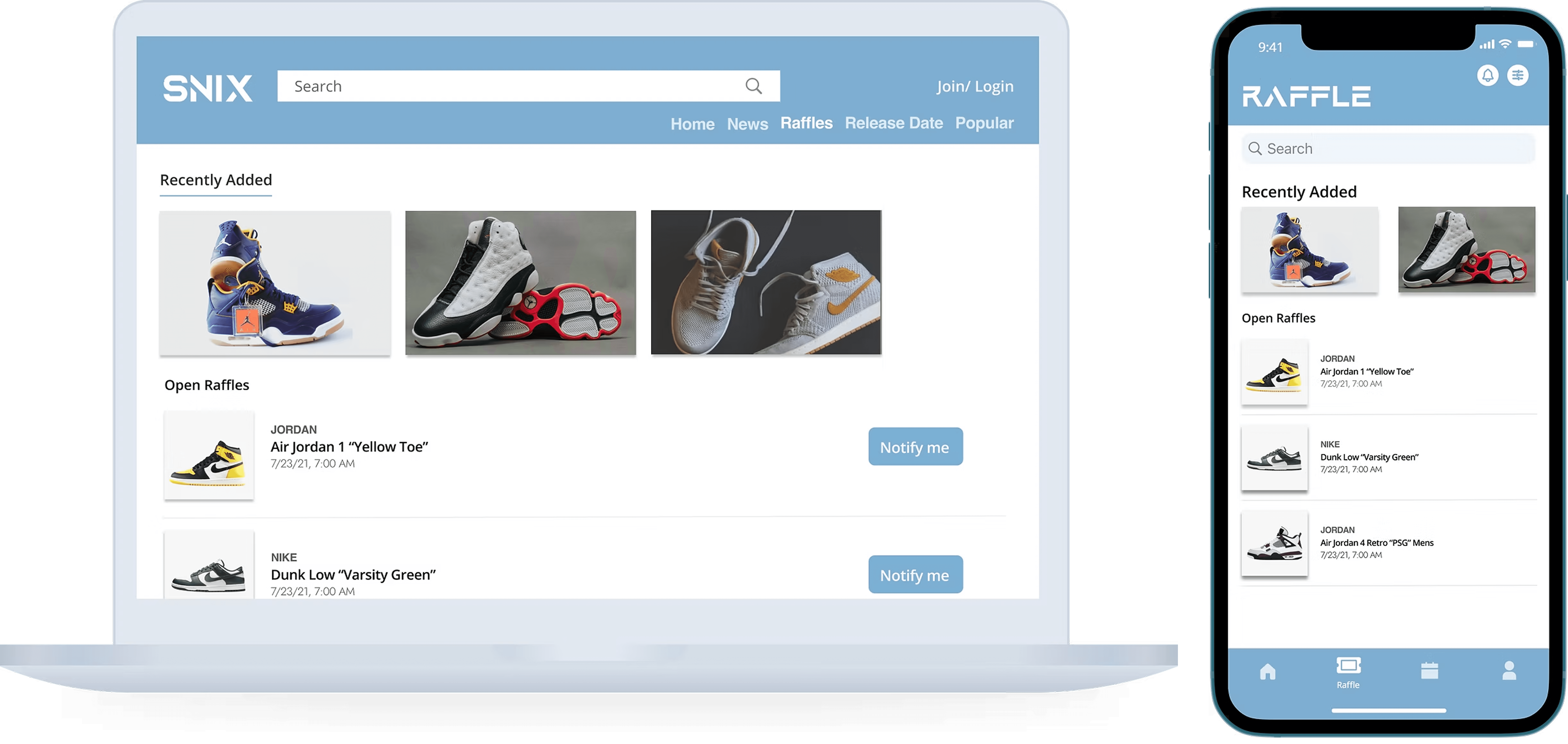
The transparency layer. This was the most significant innovation in the redesign. For the first time, users could see their entry confirmation, live raffle status open, closed, selecting and a plain-language explanation of how the outcome was determined.
When a raffle closed, instead of a binary win or lose notification, users saw: "Selected randomly from 12,482 verified entries." That single sentence answered every question users had been asking for years. It confirmed their entry was real. It confirmed the pool was large and competitive. And it confirmed the selection was random, not rigged.
The post-raffle experience. Previously, losing a raffle was a dead end. A notification, a closed door, nothing else. The redesign turned the loss state into an active moment: recommended alternatives surfaced based on style and size, upcoming drops relevant to the user's history, and a direct path to the secondary market for that specific shoe.
Winning was equally intentional, a direct purchase flow with the user's size pre-selected, minimal steps to checkout, and a clear countdown on the purchase window. The win state was designed to convert, not just celebrate.
The tradeoffs I made
Every meaningful design decision in this project involved a real tradeoff. I made these explicitly, not as compromises, but as intentional choices with documented reasoning.
The most contested was the equal weight raffle versus a loyalty-based priority system. A loyalty model would reward returning users and incentivize engagement but it would also mean that users with more history had a statistically better chance of winning.
That directly contradicted the core trust argument. I chose fairness over loyalty, with full awareness that it left engagement incentives on the table.